Maybe love is the talent.

I was never a promising musician. Never a talent. As a child I could sing in tune, but that was about it. I never learnt to play the recorder, and when I took up acoustic guitar aged 15… Well, it took me about three years just learning to tune it. The penny refused to drop. Chords, scales. It just never came easy.

So, progress was slow. I formed my first band when I was 28, writing the songs, singing and strumming. We called it quits when we all got too many kids. Some time later I did a one year stint in another (very kind) band as a (very limited) lead guitarist.  Continue reading

License to suck

AI is coming. We’ve all heard it. Depending on your knowledge your view of it may be more or less vague. Machine learning. Deep machine learning. There are many buzzwords for sure and a lot of people using them wrong or half-wrong. I better watch my tongue.

AI is seeping into music too. I think there was some artificial popstar from Japan or Korea a few years back. But AI is available for us all. Google Magenta is a series of free AI-powered tools for music making that can be used with Ableton Live. Helping your beats groove like your favourite drummer or continuing on the melody you’ve only written half of.

I’m sure the tools can be great and could take me in interesting directions. Still, I haven’t used them. Maybe that could be a challenge?

Anyway, for me the promise/threat of AI raises the question of humanity. What’s human in our music, what is important? What makes it feel real? I don’t intend to enter into any discussion if acoustic or finger-played instruments are more human than programmed, or let’s say quantized midi.

Maybe it is the human esthetic decision making that is important? Because no matter if I program my notes or play them in my choices will reflect my taste, my experience of the music that I’ve heard.

There’s this quote by Brian Eno:

“Whatever you now find weird, ugly, uncomfortable and nasty about a new medium will surely become its signature. CD distortion, the jitteriness of digital video, the crap sound of 8-bit – all of these will be cherished and emulated as soon as they can be avoided.”

Well, what if we think about the human body as a medium for music? Its imperfections can now be avoided. We have auto-tune, we can correct mistakes, quantize and move notes in time.

Will this make pitchy vocal takes more desirable? I think we might already be there. AI can also emulate ”perfect imperfection” – perfectly lazy grooves slightly behind the beat etc, even with random mistakes thrown in for extra human-ness.

How do we compete? Do we need to? What is important? What do we want our music to be? Communication? Are we fine with the music equivalent of the AI-powered talk-bots we are getting at call centers?

I find asking myself these questions more interesting than any special answer. But lately I’ve had a growing feeling of my ”crapness” being allowed. There’s no best. There’s just different. Also when it comes to music equipment. I’m feeling less ashamed of my technical limitations on my instruments. I’m not the world’s best singer, guitarist – but neither am I the world’s best friend, dad or partner. I’m not even the worst. I’m half-crap in my own unique way. In music, as well as in life.

Maybe we’re not loved in spite of our shortcomings, but because of them.
Remixing and reacting

Remixing other people’s music is interesting. I have only done it a few times, but I’ve found the experience very rewarding. Creatively you are forced to stay in the box – only to realize there’s a universe of possibilities in there. In a way it works like co-writing… in the best way? You can react to somebody else’s ideas – being inspired by them – but you never have to compromise your idea or gut feeling once you know where you’re heading.

Here are two remixes I’ve done. I don’t care too much for genres, but I suppose deep house might be most fitting. At least it’s my favourite style of house.

Jamuary 13 – PogBrute.

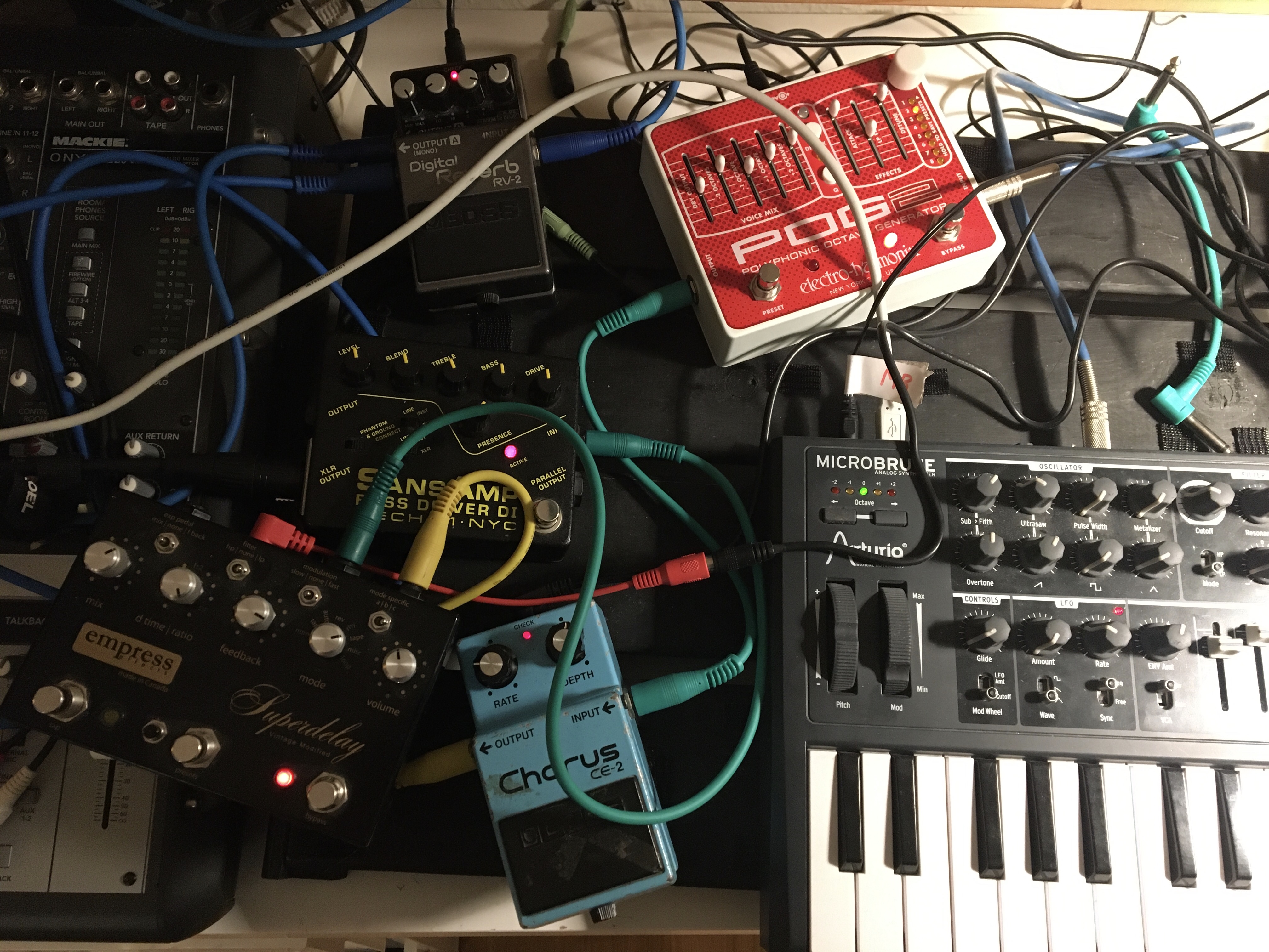
Just a quick one before bedtime. I wanted to see what the Electro Harmonix POG 2 could bring to my Microbrute. In an annoying way a POG seems to turn everything into an organ. But when in the Vatican… My idea was to get a chordal texture going with multiple octaves, slow attack and slow delay to get a big buildup.

I thought it ended up quite nice. I had forgotten about how cool the detune-setting on the POG is. This is probably pretty useful since it can simulate a doubling effect, as if layered with another oscillator. POG also has an Attack-fader for swells and a Lo-pass filter to tame excessive digital highs. I just improvised a folky melody on the black keys. I often get some kind of Scotland/Highland-feel doing that. Bagpipes or what not.

A nice thing with the POG is that it has faders that you could actually tweak live. Like swelling in some extra low oompf on the sub-octaves. Picking together an electronic live-setup is a small goal for 2021 as well.

Here’s today’s setup: Microbrute – Pog2 – Boss CE-2 – Empress VMSD – Sansamp (Boss RV-2 on an aux send from mixer.) The main pad/melody is just this. I also added some sprinkles of granular delay with the Empress VMSD reverse setting but left the POG off. Organ on organ didn’t seem like a good idea. (Too tired now, just held back an organ-donor joke).

Rain is cruel

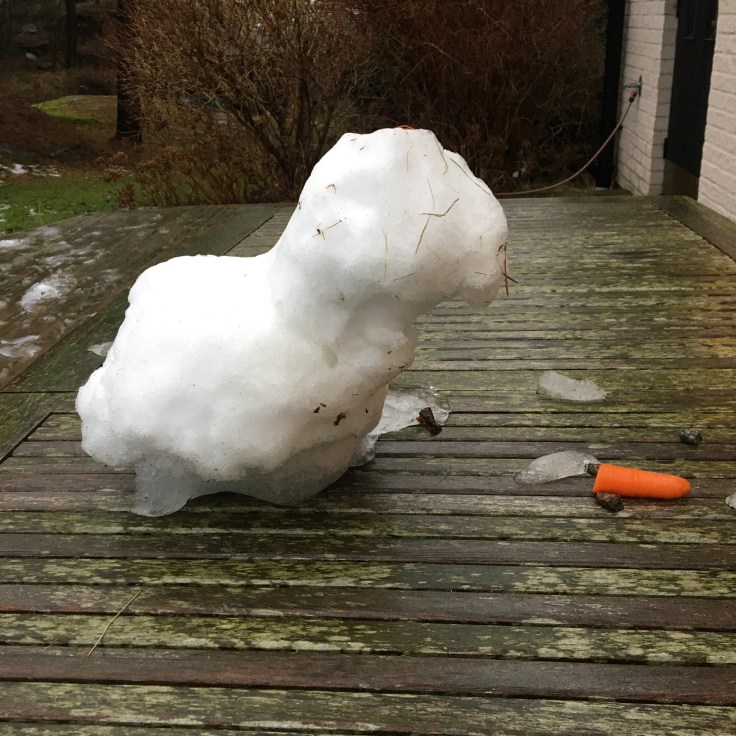
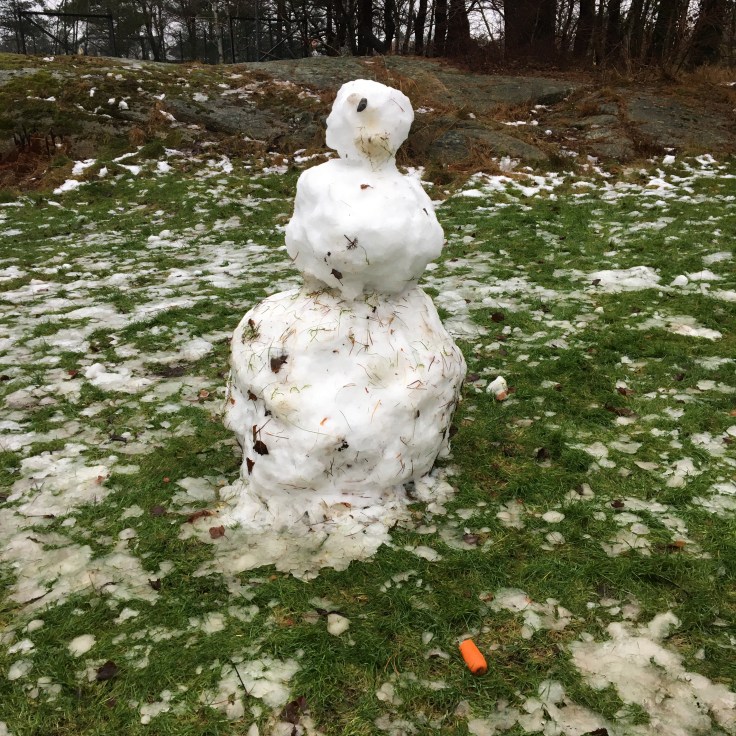
It snowed. And now it rains. Snow rarely stays around here. It used to when I was a child. Knowing white joy is short lived, my children finally saw a reason to leave their screens inside and head out.

I was raised to respect food. I always feel bad for the carrot. On the other hand I’d be willing to sacrifice a lot more on the altar of creativity for the chance of my kids making stuff.

Week 1.

Someone have to keep track of how I’m doing. It better be me. The first week 2021 I wrote one new song (music+lyric), I managed 5 Microbrute jams + one acoustic jam. I also did a live video take of me jamming on Push/APC-40 with a Chaka Khan-sample.

Whatever floats one’s boat, but gamification seems to work for me. For the last year I’ve kept a habit tracker. Ticking of my habits every day. This year I’ve decided to try to tick six boxes every day:

  • Exercise
  • Lyric writing
  • Make music
  • Phone a friend/relative
  • Share/publish (blog included)
  • Clean my studio

For now, I’m definitely most behind on phoning friends.

Jamuary 9 – FluteBrute

My idea for today was to see if I could make the Microbrute sound soft and beautiful. I ended up with three tracks.

1 – A step sequenced descending melody on Microbrute through Empress VMSD with its reverse granular delay setting. I have it pretty dry at the beginning and turn up the wet later on.

2 – a descending bass with tempo synced PWM (mostly square wave I believe).

3. And last – a flutey sound that I played by hand. The delay was set with tap tempo and drifts off a little, or if it’s my timing that is off. I’ll call that human for now.

Oh, and just to get some texture I quickly picked a field recording of rain and thunder. Not really the weather around here right now. But it was a quick choice.

When doing these kind of jams I just start. I stay on the white keys so I’m in key. Getting lost and finding your way out is not a bad idea for exploring. I have a similar experience when finding my ways through unusual tunings on guitar. In a way, it’s counter-productive because I’ve found I often gravitate towards establishing very simple structures like I – IV- V. On the other hand, these simple structures take on a new beauty when I’m lost, whereas I would find them just bland and boring if I had been doing it in standard tuning.

Here’s today’s jam:

Flutey Brute

Ice Cube – how low can you go?

Disquiet Junto is a weekly challenge initiated by Marc Weidenbaum. It’s a great concept. Every week there’s an assignment (very) open to interpretation. It’s up to you to decide how much time to devote to it. Whenever I join in, which isn’t as often as I would like to, it’s with the idea of getting something done quickly. Not being embarassed. What I’ve found is that freed from the pressure of doing something great I often come up with something interesting (at least for me). I get to learn something by being reckless and experimental.

For this week’s Junto – Disquiet Junto Project 0471: Phase Transition – the task was this: Please record the sound of an ice cube rattling in a glass, and make something of it.

I recorded. I repitched and resampled. Chopped and arranged a little sequence. I also added a Granular Delay. It’s nothing special. Still it’s interesting to see how much sonic information there can be in just ice and glass.

This was the first Junto of the year, so I wanted to join in. On the other hand, I also see that all these extra assignments can be a way throw myself off course and step away from the “real” work I intended to do. Because yes, there are lots of half-finished projects lying around here.

The value of primitive tools

As written before I’m devoting January to learning my Arturia Microbrute. It’s a small cheap synth. Compared to what’s out there it can in many regards be seen as primitive. Crude, rude and well … a brute. It doesn’t automatically make sounds that come out as lush, ambient, lovely and beautiful. It forces me to work. To find ways around its constraints.

The good thing with doing this work I believe is that there will be more Me in the music. For a year or two I’ve lusted after an analog polysynth, especially the Korg Minilogue XD. Pricewise, it’s absolutely affordable. But so far I’ve withstood the impulse. Partly because I’m fearing that in my hands it will end up a preset-machine for pads. Making all the lovely lush atmospheres that never fail to impress me.

Exploring the Microbrute has already taught me a few things. Understanding how it works in itself, but more importantly understanding how it could work for me. I’m beginning to see how I could fuse simple Berlin School step sequences with my acoustic singer-songwriter music and maybe arriving at something that I could find interesting. Transposing a step sequence up and down to fit different chords also leads to interesting “mistakes” and forces my melody-composing (which I always do singing) to handle or include notes foreign to the scale etc. This might force or ignite new solutions that I wouldn’t come up with if I had a tool capable of everything. Which I suppose I have in my digital audio workstation, Ableton Live.

An acoustic instrument, like a guitar, is actually really primitive. Tensioned strings vibrating over a resonant body. And still building a great one is infinitely complex. Getting good at playing takes work. And yet it allows for so many different expressions and styles.

I also think there’s great value in staying with one tool. Digging deeper to let it reveal itself. I have often run around with my shovel and put it in the ground for a single-take. Trying a technique only once, only to forget it. This of course resonates with the popular/famous Bruce Lee-quote:

I fear not the man who has practiced 10,000 kicks once, but I fear the man who has practiced one kick 10,000 times.

So, it feels good to stay with this crude little synth. I probably need to come up with a list of challenges to explore it in a few different directions.

PS. In the last few days I have only made small voice-memos on my phone for my Jamuary entries. And yesterday only one with acoustic guitar. Sometimes you have to put your family before your synth. 😉

Jamuary 6: Love on a real train

Monophonic synths can only play one note at a time. This means playing chords is a challenge, or actually impossible. The solution is to play record every note of your chords separately. Although it’s more work, it comes with the benefit that you can dial in a new sound for every note – making your chords into lush pads.

Instead of doing any composition myself, this day’s jam was a riff on the song Love on a Real Train by German electronic legends Tangerine Dream. I came across remixes of this song a decade ago and it always struck me as a good use of a simple step sequencer as in the main repeating riff.

Here are a few different versions and last my jam for today – I seem to have made the riff in halftempo, without really knowing. Wasn’t that focused on doing anything verbatim, rather I focused on what I could do with the Microbrute.

Continue reading